
01
The audit
30 minutes, by video
Google Meet · 30 min
Where the money goes
3 hrs/day re-keying
Hours, spread, bonuses and absences entered where they happen, then sent to your accountant or payroll software in its own format.
Payroll isn't the problem: what costs is what happens before it. Hours live in three places, bonuses arrive by email, and someone assembles it all by hand the day before closing. An error made at that point surfaces on the pay stub, and gets corrected the month after.
assembled by hand
Close
28
of the month
error found on the pay stub
corrected the month after
Hours are entered where the work happens and attached to what justifies them: a route, a site, a shift. Spread of hours, premiums, bonuses and absences follow your pay rules — union agreement or company policy — written once and applied from then on.
It's the second data entry that costs money and gets things wrong. That's the one we remove.
Your pay rules
written once
This month
Payroll stays with your accountant or your software vendor, with their obligations and regulatory updates. The export format is agreed with them before go-live, on a test month compared with the previous one: an export the accountant has to rework has saved nobody anything.
The record itself is timestamped, kept and exportable: what the FLSA asks of a time record, whatever the method.
agreed before go-live
Test month
Previous month
Four steps, and a figure before we talk price.
01
30 minutes, by video
Where the money goes
02
on your own data
03
a fixed price, in writing
04
delivered in pieces
50 %
then the subscription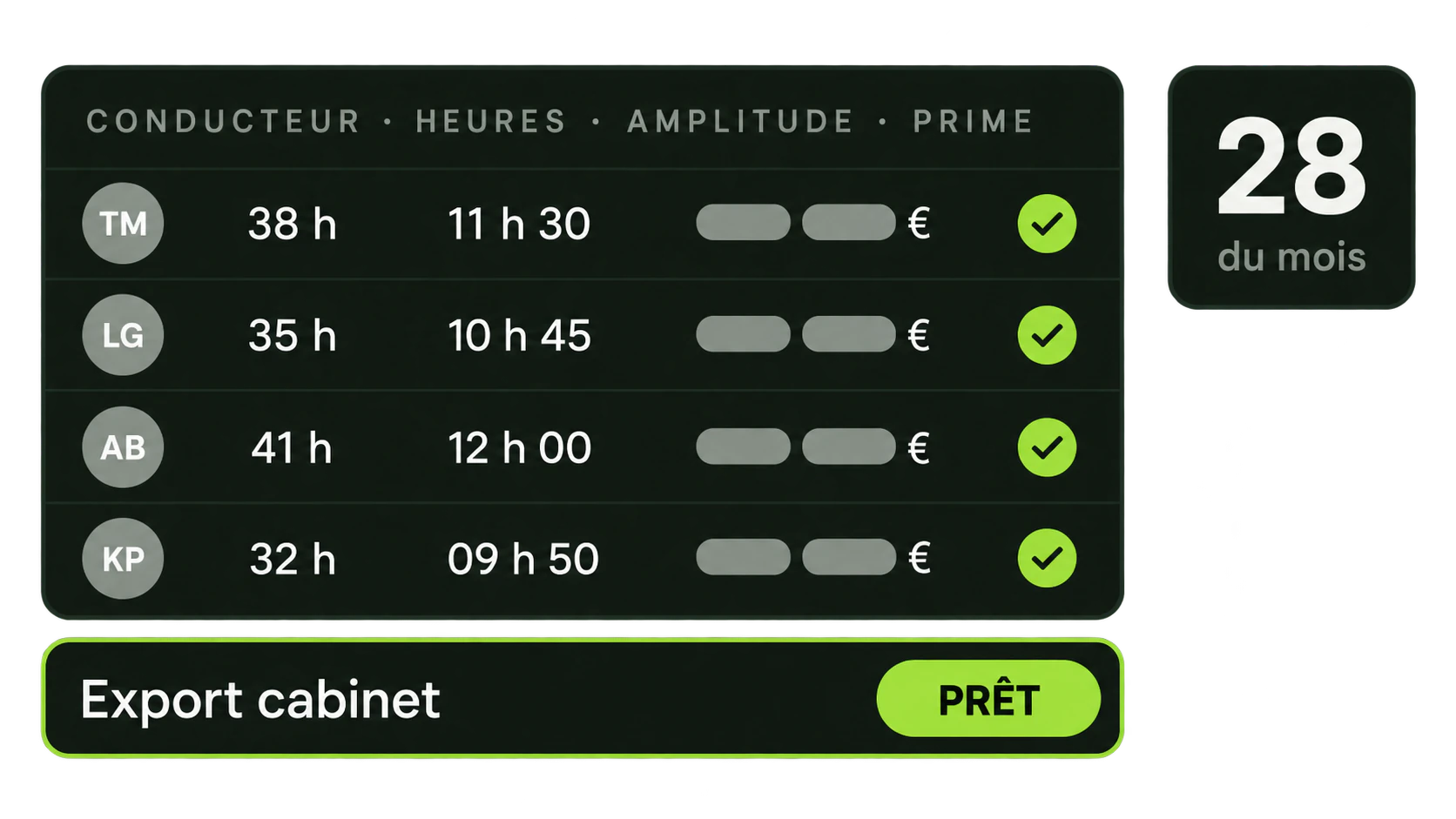
Their words, exactly as they wrote them to us.
Communication was fast and effective throughout the project. They analyzed our needs perfectly and met them 100%, if not more — genuinely high standard, while staying true to the offer. Timelines were excellent. What really struck us was their expertise: they guided us and explained their choices clearly, bringing real know-how about what converts. Serious, responsive and expert — I recommend them without hesitation!

Steve Bron
Co-founder, Buckmoon Agency
The Edenio team was incredibly committed from the start. They understood our brand world, our tone and our technical constraints. The design is modern, clear and true to who we are. Communication was always smooth, deadlines were met, and their strategic advice on user experience had a real impact on our conversions.

Jeremy Boissinot
CEO, Favikon
The team did a fabulous job. Their support from start to finish, their professionalism, commitment and recommendations mean I'll be working with them again! I've finally found my go-to agency! I highly recommend them — you can go in with your eyes closed.

Maxime Dohollo
CEO, Agence Nuisibles
We worked together for several months and I'm fully satisfied with what was delivered. He quickly grasped how complex and varied our offer is, and put in place a clear, smooth, well-thought-out process.

Alexandre Velardocchio
Co-founder and CEO, Gust
Here are the first three qualities that come to mind: professionalism, integrity, efficiency. Thank you for our exchanges and for the work delivered. I recommend them.

Fabien Nahum
Head of Sales, Opsima
And if yours isn't here, ask us directly.
No, deliberately. Payroll stays with your accountant or your vendor, with its obligations and regulatory updates. We prepare what they expect: inputs that are correct, complete and on time.
The FLSA requires an accurate record of hours worked, without prescribing the method. A timestamped record, kept and exportable, meets that duty; some states add their own rules.
At least two years for time cards and three for payroll records under the FLSA, longer in some states. They stay exportable at any time.
We settle it with them before go-live, on a test month compared with the previous one. An export the accountant has to rework has saved nobody anything.
Their hours are entered in the same place, with the right distinction: they don't go to payroll, but they count toward the real cost of a route or a site.
Let's talk
We look at how you work, and give you the number that goes with it.
No commitment · You pick the time



 Jérôme Knops
