
01
The audit
30 minutes, by video
Google Meet · 30 min
Where the money goes
3 hrs/day re-keying
The status of every shipment is on screen, and the real cost of the route is set against what was planned.
Operations spends its day as a go-between: the client calls, you call the driver, you call the client back. Three interruptions for information nobody wrote down — and meanwhile the route's real cost waits until month end to be rebuilt in a separate spreadsheet.
3 interruptions
Route cost
rebuilt at month end
Each shipment carries its status — prepared, loaded, on the road, delivered, held — entered by the people doing the work, as they do it, in about ten seconds and with gloves on. The information is no longer chased by phone: it's already there.
The client gets a link: they see where their delivery stands without contacting you, and the 10 a.m. call stops happening.
Shipment #214
usable with gloves
Delay flagged
Tracking your delivery
no account to create
The reconciliation almost nobody does: what was planned for the route, what it actually cost, and the gap. It's computed from what's already entered — driver hours, mileage, attached purchases, subcontracting — without a single extra entry, because nobody would make it.
The lines that lose money stop being an impression, and get discussed on figures when it's time to renegotiate.
Route 12
no extra data entry
Four steps, and a figure before we talk price.
01
30 minutes, by video
Where the money goes
02
on your own data
03
a fixed price, in writing
04
delivered in pieces
50 %
then the subscription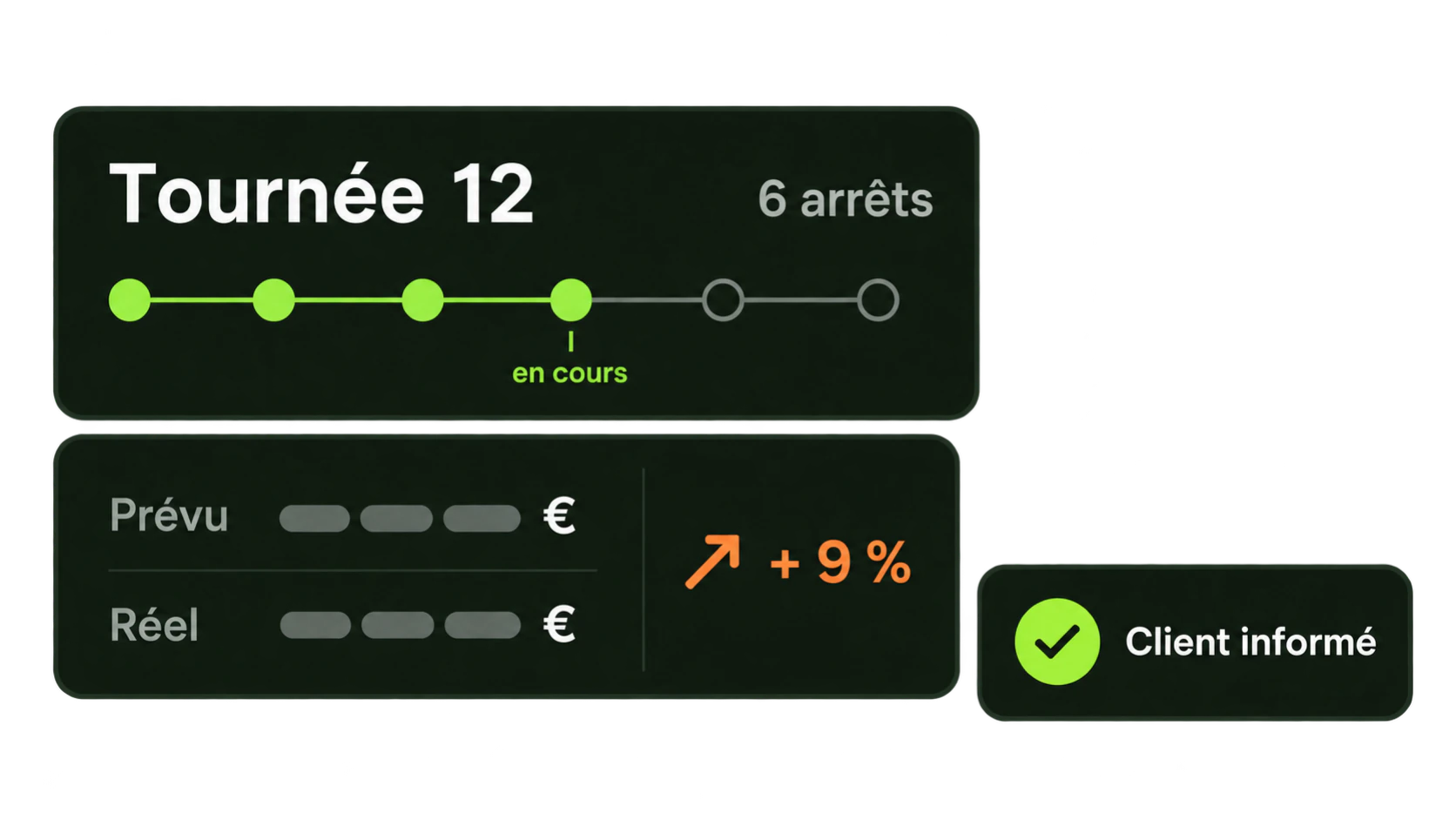
Their words, exactly as they wrote them to us.
Communication was fast and effective throughout the project. They analyzed our needs perfectly and met them 100%, if not more — genuinely high standard, while staying true to the offer. Timelines were excellent. What really struck us was their expertise: they guided us and explained their choices clearly, bringing real know-how about what converts. Serious, responsive and expert — I recommend them without hesitation!

Steve Bron
Co-founder, Buckmoon Agency
The Edenio team was incredibly committed from the start. They understood our brand world, our tone and our technical constraints. The design is modern, clear and true to who we are. Communication was always smooth, deadlines were met, and their strategic advice on user experience had a real impact on our conversions.

Jeremy Boissinot
CEO, Favikon
The team did a fabulous job. Their support from start to finish, their professionalism, commitment and recommendations mean I'll be working with them again! I've finally found my go-to agency! I highly recommend them — you can go in with your eyes closed.

Maxime Dohollo
CEO, Agence Nuisibles
We worked together for several months and I'm fully satisfied with what was delivered. He quickly grasped how complex and varied our offer is, and put in place a clear, smooth, well-thought-out process.

Alexandre Velardocchio
Co-founder and CEO, Gust
Here are the first three qualities that come to mind: professionalism, integrity, efficiency. Thank you for our exchanges and for the work delivered. I recommend them.

Fabien Nahum
Head of Sales, Opsima
And if yours isn't here, ask us directly.
No. Statuses come from a short entry at each step, which is enough to answer the client. If you already have telematics, we connect to it rather than add a second system.
They see what you choose to show, through a link, with no account to create: the status of their delivery and nothing else. That link is what makes the 10 a.m. call disappear.
They are tracked like the rest, with access limited to their own shipments. The spreadsheet kept on the side is exactly what this removes.
From what is already entered: driver hours, mileage, purchases attached, subcontracting. There is no extra entry to compute it, because nobody would do it.
No, and if yours handles the transport plan well, keep it. We cover what usually stays outside: tracking as the client sees it, real cost, and what happens when things go wrong.
Let's talk
We look at how you work, and give you the number that goes with it.
No commitment · You pick the time



 Jérôme Knops
